oneworld Alliance: The Complete 2026 Guide
oneworld in 2026: the live 15-member roster, Ruby, Sapphire and Emerald benefits, the best frequent-flyer programmes to hold, the strongest…
Read article →Independent Miles Mosaic guide. No programme partnerships, no account linking, no scraped balances. Sources cited below; corrections welcomed.
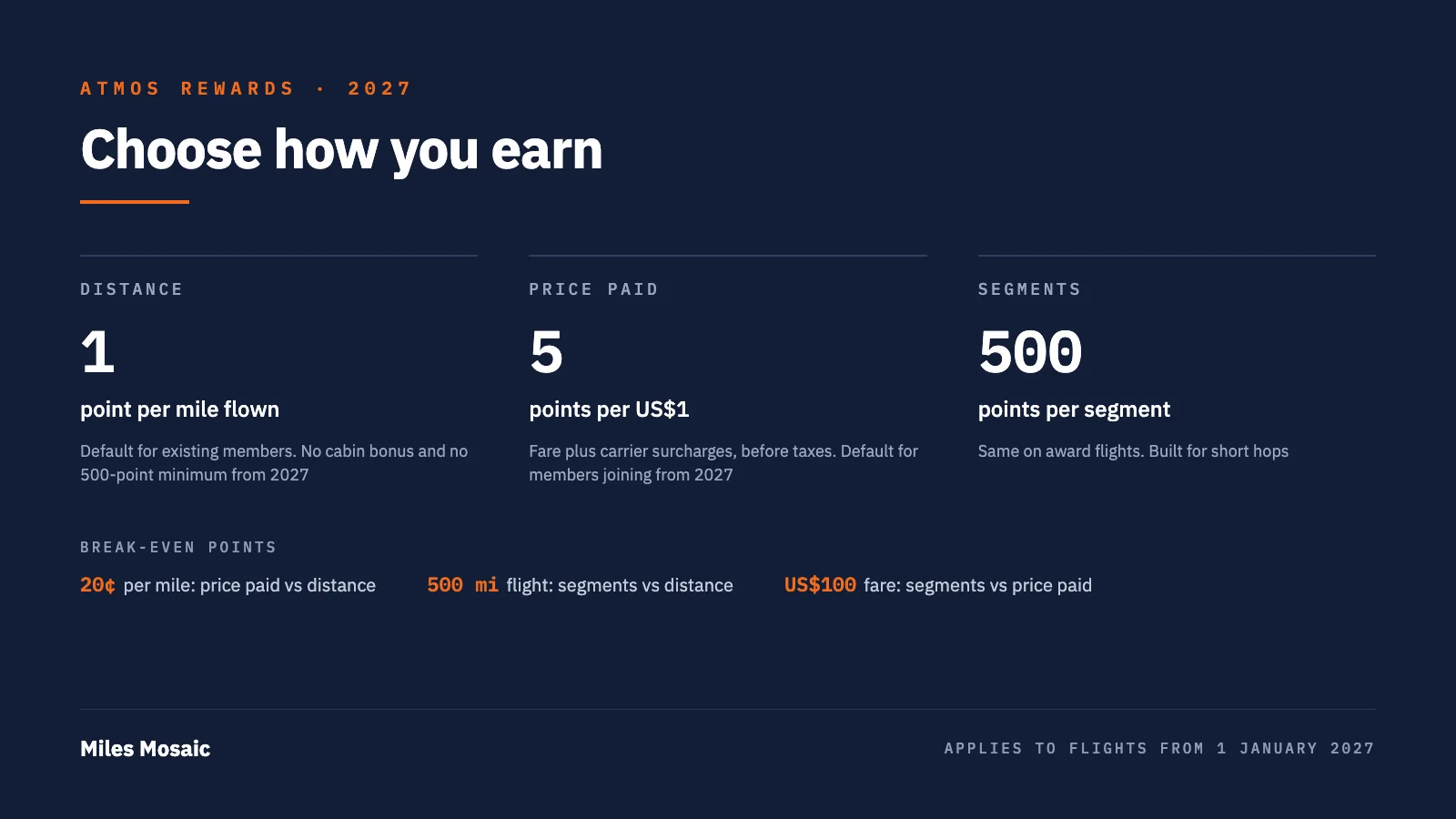
Atmos Rewards, the programme shared by Alaska Airlines and Hawaiian Airlines, now lets every member choose how flights earn: 1 point per mile flown, 5 points per US dollar paid, or 500 points per segment. The choice sets both redeemable points and status points, applies to flights from 1 January 2027, and can be changed once a calendar year.
Doing nothing is itself a choice here. Existing members who do not pick stay on distance, but distance earning in 2027 is not the distance earning they have today: it loses its cabin bonuses and its short-flight minimum. And for members who credit oneworld partner flights to Atmos, the method now decides how a ticket bought on Cathay Pacific’s or Japan Airlines’ own website earns, which is the part of this change most coverage skips.
Alaska opened the selection on 1 October 2026, two days after its 29 September announcement. The rates on its “Choose how you earn” page are these.
| Method | Points and status points on paid flights | Status points on award flights | What else changes |
|---|---|---|---|
| Distance traveled | 1 per mile flown | 1 per mile flown | No class-of-service bonus and no 500-point minimum on flights under 500 miles |
| Price paid | 5 per US$1, excluding taxes and fees but including carrier-imposed surcharges | 1 per 20 points redeemed | Paid cabin upgrades and eligible paid seats on Alaska and Hawaiian, such as Premium Class and exit rows, also earn |
| Segments flown | 500 per segment | 500 per segment | A segment is one flight number, even if it stops on the way |
Four rules sit underneath the table, and they matter more than the headline rates.
The status thresholds do not change: 20,000 status points for Atmos Silver (oneworld Ruby), 40,000 for Gold (oneworld Sapphire), 80,000 for Platinum and 135,000 for Titanium (both oneworld Emerald), counted over the calendar year. Our explainer on status currencies covers how Atmos status points compare with the units other programmes use.
All three methods pay out in the same unit, so the comparison is arithmetic rather than judgement.
| Comparison | Break-even | Rule of thumb |
|---|---|---|
| Price paid against distance | 20 US cents per mile flown | Pay more than 20 cents a mile before taxes and price paid wins |
| Segments against distance | 500 miles per flight | Flights shorter than 500 miles favour segments |
| Segments against price paid | US$100 per flight before taxes | Fares under US$100 a segment favour segments |
A US$500 one-way fare on a 2,500-mile flight earns 2,500 under either distance or price paid; that is the 20-cent line. The same flight earns 500 by segment.
The table below runs a handful of typical trips through all three methods. Distances are airport-to-airport; the fares are illustrative, before taxes, and chosen to show where each method pulls ahead rather than to predict what you will pay.
| Trip | Distance | Price paid | Segments |
|---|---|---|---|
| Honolulu to Kahului, 100 miles, US$59 fare | 100 | 295 | 500 |
| Seattle to Los Angeles, 954 miles, US$129 economy | 954 | 645 | 500 |
| Seattle to New York JFK, 2,421 miles, US$899 first class | 2,421 | 4,495 | 500 |
| Award, 2,500 miles, 12,500 points redeemed (status points only) | 2,500 | 625 | 500 |
Segments looks generous until you count. Silver at 500 a segment is 40 qualifying flights before bonuses; Gold is 80. Alaska’s examples are Hawaiian inter-island hops and flights within California, but the logic is simply short sectors: an eligible 300-mile partner economy flight earns 300 under distance, 150 on the price-paid partner chart and 500 by segment. Segments suits members whose eligible flying is dominated by short sectors; compare annual totals, because a few long flights reverse the result quickly.
For most members the real decision is between distance and price paid, and it turns on four questions.
Most discounted economy fares on longer domestic routes fall below 20 cents a mile, which is why distance remains the safer default for leisure flyers. The calculation flips for travellers who regularly buy flexible economy, first class, or short routes where the fare is high relative to the distance: a US$250 fare on a 600-mile business route is about 42 cents a mile, and earns more than twice as much under price paid.
Use your own last twelve months rather than a rule of thumb. Alaska’s “Help me choose” tool shows signed-in members how their flights through 31 August 2026 would have earned under each method. Treat it as a starting point and spot-check a few flights by hand, because the tool is modelling a future set of rules against a past year of fares.
Paid upgrades and eligible seat fees on Alaska and Hawaiian earn only under price paid. If you regularly pay to move into Premium Class or first, that spend is worth points and status points, but only if you choose price paid. Because distance earners also lose the class-of-service bonus in 2027, a habit of buying up is one of the clearest signals for price paid.
This one is easy to miss. For eligible awards booked with Atmos points, distance earns status points by miles flown. Under price paid they earn one status point for every 20 points redeemed. For a member who redeems often on good-value awards, that is a large cut: the 2,500-mile award in the table above produces 2,500 status points under distance and 625 under price paid. If a meaningful share of your tier comes from award travel, that gap can decide the question on its own.
Alaska’s 2027 partner earning page splits partner flights by where the ticket was issued, which you can read from the first three digits of the ticket number.
| Where booked | Distance | Price paid | Segments |
|---|---|---|---|
| Alaska, Hawaiian or a partner flight booked through Alaska or Hawaiian (ticket starts 027) | 1 per mile | 5 per US$1 | 500 per segment |
| American Airlines-marketed flight booked through American (ticket starts 001) | 1 per mile | 5 per US$1 | 500 per segment |
| Any other eligible partner flight booked elsewhere (ticket starts with other digits) | 1 per mile | Partner chart, by cabin (below) | 500 per segment |
A travel agency booking follows the same split: Alaska says an eligible agency ticket earns 5 points per US$1 under price paid if its number begins 027 or 001, and the partner chart otherwise. The partner chart applies only if you have chosen price paid, and only to tickets issued by someone other than Alaska, Hawaiian or American. It pays a percentage of the actual distance flown:
| Cabin | Points and status points |
|---|---|
| International business or first | 250% |
| Domestic business or first | 150% |
| Premium economy | 100% |
| Economy | 50% |
| Discount economy | 25% |
Alaska adds that STARLUX and Philippine Airlines flights booked on partner sites earn no Atmos status points at present.
For a oneworld traveller based in Asia-Pacific who rarely flies Alaska and uses Atmos to credit Cathay Pacific, Japan Airlines or Qantas flights, this is where the choice has real teeth, and it cuts both ways.
Take Hong Kong to London, roughly 6,000 miles, booked on Cathay’s own website. Under distance it earns about 6,000 points and status points whatever the cabin. Under price paid the same flight earns about 15,000 in business class at 250%, but only about 1,500 in discount economy at 25%. Under segments it earns 500.
That produces three plain rules for a partner-heavy member:
Two caveats before you commit. Fare eligibility still applies: Alaska’s partner terms exclude the lowest fare types on many partners, and carriers such as Cathay sell fare families rather than simple booking codes, so confirm that your fare earns before assuming it does. And these partner rules are new; the cabin a partner files your fare under decides which row of the chart you land in, so check the first few postings against your boarding passes.
Atmos is not the only oneworld programme changing its year in 2027. If you are deciding where to credit Cathay flying at all, our guide to Cathay’s 2027 loyalty overhaul covers the home programme, and our piece on Qantas Frequent Flyer’s 2026 and 2027 changes covers the other common choice for Asia-Pacific members.
The honest answer for most members is that the right option depends less on the rates than on the trips already in the calendar. List next year’s booked and likely flights, note the fare, the distance, where each was booked and whether any are awards, and run all three numbers against your target tier. That year-ahead view, whether the trips you have will get you to the tier you want, is what tracking status across programmes is about, and it is the problem Miles Mosaic is built around for the 31 programmes it supports, Atmos Rewards among them. Whichever method you pick, the points themselves do not expire, as our Atmos Rewards points expiry page sets out; it is only the status count that resets each January.
See your requalification forecast in under a minute. No account, and never a loyalty password.
Forecast my status, free →Share
Last reviewed: · How we research and update
oneworld in 2026: the live 15-member roster, Ruby, Sapphire and Emerald benefits, the best frequent-flyer programmes to hold, the strongest…
Read article →Some basic fares earn full miles and status while blocking upgrades. Others earn nothing at all. The 2026 rules, carrier by carrier.
Read article →Cathay's programme changes on 1 January 2027: Status Points stop resetting, membership moves to calendar years, rollover arrives and Diamon…
Read article →A plain-English guide to every major airline and hotel status currency: what Tier Points, MQDs, PQPs, XP and Loyalty Points are, how each i…
Read article →